Sep 3, 2026Technical Guides
How to Choose a Reliable LED Strip Manufacturer in China
Complete sourcing guide for finding a reliable LED strip light manufacturer in China. Learn what to evaluate: certifications, QC, MOQ, factory audits, and red flags to avoid.
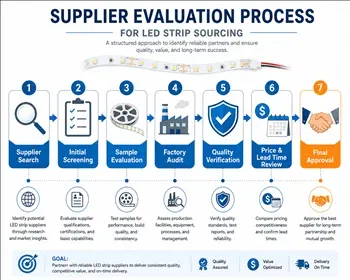
How to Choose a Reliable LED Strip Light Manufacturer in China: Complete Sourcing Guide
China produces the majority of the world's LED strip lights, with manufacturing concentrated in Shenzhen, Dongguan, and Zhongshan. For distributors, wholesalers, contractors, and lighting brands in Europe and North America, finding a reliable LED strip manufacturer in China can mean the difference between a profitable product line and a costly quality nightmare. This guide walks you through every step of the evaluation process — from initial supplier search to factory audit and long-term partnership — so you can confidently choose an LED strip supplier that meets your quality, pricing, and delivery requirements.
With thousands of suppliers advertising online, the challenge isn't finding a manufacturer — it's finding the right one. We're an LED strip manufacturer ourselves (HST Light, Shenzhen), so we have skin in the game: the checklist below is exactly what we'd want a buyer to verify with us — and with any other supplier. If you're still deciding between COB and SMD technology, our COB vs SMD comparison covers that first step.
Why Source LED Strip Lights from China?
Before diving into supplier evaluation, it's worth understanding why China remains the dominant force in LED strip manufacturing:
- Cost efficiency: Lower labor and material costs translate to 20–50% savings compared to domestic manufacturing
- Complete supply chain: From LED chips and PCBs to silicone and drivers, every component is available locally
- Manufacturing expertise: Shenzhen alone has hundreds of specialized LED strip factories with deep technical know-how
- Scale flexibility: Chinese manufacturers can handle everything from small custom runs to million-meter orders
- Export infrastructure: Established logistics networks for global shipping, with experience handling CE, UL, and other compliance requirements
However, quality varies enormously across the market. The same SMD2835 strip can be made with top-tier Samsung chips or low-grade no-name chips — and the price difference might be only 10–15%. Knowing how to evaluate suppliers is essential.
Step 1: Define Your Requirements Before Contacting Suppliers
Before reaching out to any LED strip manufacturer, clearly document your technical and commercial requirements. A precise spec sheet helps you compare suppliers apples-to-apples and filters out those who can't meet your standards.
Key Specifications to Define
Category | Details to Specify |
|---|---|
LED technology | COB or SMD (chip type: 2835, 5050, 3014, etc.) |
Electrical | Voltage (5V/12V/24V/48V), wattage per meter |
Optical | CCT (2700K–6500K), CRI (80+/90+/95+), lumens per meter |
Physical | PCB width (4–12mm), LED density, color of PCB (white/black/brown) |
Protection | |
Color options | Single color, tunable white (CCT), RGB, RGBW, RGB+CCT |
Accessories | Connectors, aluminum profiles, controllers, power supplies |
Certifications | CE, RoHS, UL, ETL, FCC, Energy Star |
Packaging | Standard or custom retail packaging, private-label branding |
Commercial | MOQ, lead time, payment terms, Incoterms (FOB, EXW, DDP) |
Step 2: Where to Find LED Strip Manufacturers in China
B2B Platforms
- Alibaba: The largest B2B marketplace. Filter by "Verified Supplier," "Trade Assurance," and "Gold Supplier" status. Look for suppliers with 5+ years on the platform and response rates above 90%.
- Made-in-China: Focuses on Chinese manufacturers with factory verification. Useful for finding specialized LED strip producers.
- Global Sources: Pre-vetted suppliers with a focus on quality exporters. Trade shows in Hong Kong showcase premium manufacturers.
Trade Shows
- Canton Fair (Guangzhou): Held twice yearly (April and October). The lighting section features hundreds of LED strip manufacturers.
- Hong Kong International Lighting Fair: October and April editions. Premium venue for meeting established export-oriented manufacturers.
- Guangzhou International Lighting Exhibition (GILE): June. The largest lighting trade show in China, focused exclusively on lighting products.
Direct Search
Google searches for terms like "LED strip manufacturer Shenzhen" or "COB LED strip factory China" can surface manufacturer websites directly. This often leads to more established companies that invest in their own web presence rather than relying solely on B2B platforms.
Industry Referrals
Ask other professionals in your network — lighting designers, contractors, or industry associations — for manufacturer recommendations. Referrals often lead to the most reliable partnerships.
Step 3: Evaluate Manufacturer Credentials and Certifications
A reliable LED strip manufacturer should hold relevant certifications for your target markets. Here's what to look for:
Essential Certifications
Certification | Market | What It Covers |
|---|---|---|
CE | European Union | Safety, health, and environmental requirements |
RoHS | European Union | Restriction of hazardous substances in electronics |
UL/ETL | North America | Product safety testing and certification |
FCC | United States | Electromagnetic compatibility |
SAA | Australia | Electrical safety compliance |
ISO 9001 | Global | Quality management system |
Important Notes on Certifications
- Verify, don't just ask: Request certificate copies and verify them on the issuing body's website (UL, TÜV, Intertek). Forged certificates are unfortunately common in the industry.
- Check product-specific listings: A manufacturer may hold UL certification for one product but not another. Ensure the specific model you're purchasing is covered.
- Component certifications matter: Ask whether the LED chips (Samsung, Cree, Epistar, San'an), resistors, and PCB materials are from reputable, certified suppliers.
Step 4: Assess Manufacturing Capabilities and Quality Control
Factory Equipment and Capacity
A legitimate LED strip manufacturer should have:
- Automated SMT (Surface Mount Technology) lines: For precise, high-speed LED chip placement
- Reflow soldering ovens: For reliable solder joints
- Soldering wave machines: For PCB soldering
- Integrating sphere photometers: For photometric testing (lm/W, CCT, CRI, color coordinates)
- Aging test rooms: Where strips run continuously for 8–24 hours to catch early failures
- High-voltage test equipment: For dielectric strength testing on waterproof products
Quality Control Processes
Ask the manufacturer to describe their QC process. A robust system should include:
- Incoming material inspection (IQC): Testing LED chips, PCBs, and other components before production
- In-process quality control (IPQC): Regular checks during SMT, soldering, and waterproofing
- Final quality control (FQC): 100% visual inspection and electrical testing of finished strips
- Ongoing reliability testing: High-temperature/high-humidity testing, thermal shock testing, and bend testing
Request the manufacturer's quality control documentation, including inspection reports, defect rate statistics, and any corrective action records. A manufacturer that can't produce these documents is a red flag.
Factory Audit
For orders above $10,000–$20,000, consider conducting a factory audit — either in person or through a third-party inspection company (SGS, TÜV, Intertek, QIMA). The audit should cover:
- Production capacity and equipment condition
- Quality management system implementation
- Worker training and competency
- Environmental and safety compliance
- Inventory management and warehouse conditions
- R&D capabilities and technical expertise
If an in-person visit isn't feasible, request a live video factory tour. Manufacturers willing to show their production floor in real-time are generally more transparent than those who only provide polished marketing photos.
Step 5: Evaluate Product Quality Through Samples
Never place a bulk order without first receiving and testing samples. Here's what to test:
Sample Evaluation Checklist
- Visual inspection: Check solder joint quality, PCB cleanliness, and silicone coating uniformity (for waterproof strips)
- Photometric testing: Verify lumen output, CCT accuracy, and CRI using a spectrometer (or send samples to a third-party lab)
- Color consistency: Compare multiple strips from the same batch for CCT and brightness uniformity — delta UV should be within 0.005
- Electrical safety: Test for short circuits, insulation resistance, and dielectric strength
- Adhesive quality: Test the 3M adhesive (or equivalent) on various surfaces
- Bend and flex testing: Ensure the strip can bend without damaging components or solder joints
- Waterproof testing: For IP65+ strips, submerge or spray-test according to the claimed IP rating
- Thermal testing: Run the strip at full power for 4+ hours and measure temperature rise
Compare samples from at least 2–3 manufacturers before making a decision. For detailed photometric and safety testing, HST Light provides free samples along with full spec sheets and test reports for qualification.
Step 6: Understand Pricing and Total Cost of Ownership
Price Factors That Affect LED Strip Cost
Factor | Impact on Price |
|---|---|
LED chip brand | Samsung/Cree: +20–40%; Epistar: +5–15%; No-name: baseline |
CRI level | CRI 90+: +10–20% vs CRI 80+ |
PCB type | 2oz copper: +15–25% vs 1oz; black PCB: +5–10% vs white |
Waterproofing | IP65: +15–20%; IP67: +25–35%; IP68: +35–50% vs IP20 |
LED density | Higher density = higher cost (more chips, more SMT time) |
Silicone type | Silicone extrusion: +20–30% vs PU; PU: +10–15% vs epoxy |
Certifications | UL-listed: +15–25% vs non-certified equivalent |
Beware of Unrealistically Low Prices
If a supplier's price is 30%+ below the market average, investigate why. Common cost-cutting practices that compromise quality include:
- Using under-spec LED chips (lower bin, fewer lumens per watt)
- Reducing copper weight on the PCB (causes voltage drop and heat issues)
- Using inferior resistors that drift over time
- Skipping silicone/PU coating in favor of cheap epoxy that yellows
- Omitting aging tests to reduce production time
- Using reclaimed or counterfeit LED chips
Total Cost of Ownership
Look beyond unit price. Factor in:
- Defect rate and warranty costs: A 5% defect rate on a 10,000m order means 500m of replacements
- Shipping and customs: Heavier packaging or longer lead times can increase landed cost
- Compliance and testing: Non-certified products may fail local inspections, resulting in returns or fines
- Brand reputation: Quality failures damage your relationship with end customers
Step 7: Assess Communication, Service, and Long-Term Partnership Potential
A reliable LED strip supplier should be more than just a vendor — they should be a manufacturing partner. Evaluate:
Communication Quality
- Response time: Replies within 24 hours on business days indicate professional operations
- Technical competence: Sales engineers who can answer detailed questions about CRI, binning, thermal management, and waterproofing demonstrate real manufacturing knowledge
- Documentation: Can they provide complete spec sheets, photometric files (IES), installation guides, and compliance documents?
- Language skills: Clear English communication reduces specification errors and misunderstandings
Service Capabilities
- Custom development: Can they produce custom specifications (non-standard CCT, special PCB width, unique connectors)?
- OEM/ODM support: Do they offer private-label branding, custom packaging, and product development? See HST Light's OEM/ODM capabilities
- After-sales support: What's their warranty policy? How do they handle defective products?
- Logistics support: Can they handle DDP shipping, consolidate with other products, or provide warehousing?
Red Flags to Watch For
- No physical factory address or refuses to allow factory visits/video tours
- Cannot produce any certifications or provides certificates that can't be verified
- Only accepts 100% upfront payment with no Trade Assurance or escrow option
- No quality control documentation or inspection reports
- Unusually broad product range (claims to make everything from LED strips to solar panels to power tools — likely a trading company, not a manufacturer)
- Prices significantly below market with no technical explanation
Step 8: Start with a Trial Order
Before committing to large volumes, place a trial order — typically 500–2,000m depending on your needs. Use this order to evaluate:
- Production lead time: Does the manufacturer deliver on schedule?
- Product consistency: Does the bulk production match the sample quality?
- Packaging quality: Are the products properly protected for international shipping?
- Documentation: Do you receive complete shipping documents, spec sheets, and compliance certificates?
- Communication throughout the process: Are you kept informed of production progress and any issues?
A successful trial order builds the foundation for a long-term partnership. If any issues arise, how the manufacturer responds is just as important as the issue itself — a supplier who takes responsibility and offers prompt corrective action is a valuable partner.
Why HST Light Is a Trusted LED Strip Manufacturer in China
HST Light has been manufacturing LED strip lights in Shenzhen for over 10 years, serving distributors, contractors, and lighting brands in 80+ countries. We understand the expectations of B2B buyers in European and North American markets and have built our processes around meeting those standards.
Our Manufacturing Advantages
- 3,000㎡ factory with automated SMT lines, reflow ovens, and silicone extrusion equipment
- 20+ R&D engineers supporting custom product development and OEM/ODM projects
- Complete QC system: IQC → IPQC → FQC → aging test → reliability test
- Certifications: CE, RoHS, UL, ETL — verified and current
- Full product range: COB (180–1080 chips/m) and SMD (2835/5050/3014/3528) in all voltages, CCTs, and IP ratings
- Transparent pricing: Detailed quotations with component specifications, no hidden cost-cutting
- Free samples for qualified buyers with complete test reports
- MOQ from 500m for custom specifications; stock items with low MOQ
We invite you to request a factory tour (in person or via video), review our certifications, and test our samples. Our goal is to be your long-term LED strip manufacturing partner — not just a one-time supplier.
Conclusion
Choosing a reliable LED strip manufacturer in China requires thorough research, careful evaluation, and a methodical approach. By defining your requirements clearly, verifying certifications, assessing factory capabilities, testing samples, and starting with a trial order, you can minimize risk and build a partnership that supports your business growth for years to come.
Remember: the cheapest supplier is rarely the most reliable, and the most reliable supplier is rarely the cheapest. Focus on total value — quality, service, consistency, and partnership — rather than unit price alone.
Ready to start your LED strip sourcing journey? Contact HST Light for a detailed quotation, free samples, or to schedule a factory tour. You can also explore our product catalog or learn more about our OEM/ODM services for custom LED strip development.