Aug 28, 2026LED Product Knowledge
LED Strip Light IP Ratings Explained: IP20 to IP68 Guide
Confused about LED strip IP ratings? Complete guide to IP20, IP44, IP65, IP67, and IP68 LED strips. Learn which waterproof rating fits your indoor or outdoor project.
Understanding LED Strip Light IP Ratings: IP20 vs IP44 vs IP65 vs IP67 vs IP68 Explained
When specifying LED strip lights for any project, understanding IP (Ingress Protection) ratings is essential for ensuring product longevity, safety, and compliance. The LED strip IP rating tells you exactly how well the strip is protected against solid objects (like dust) and liquids (like water). Choosing the wrong IP rating can lead to premature product failure, safety hazards, and costly callbacks — particularly critical for contractors and distributors whose reputation depends on reliable installations.
This guide explains the IP rating system in detail, compares IP20, IP44, IP65, IP67, and IP68 LED strips, and helps you select the right waterproof LED strip rating for your specific application. Whether you're lighting a dry indoor cove or a submerged outdoor pool feature, HST Light manufactures LED strips across the full IP rating spectrum to meet your project requirements. As a manufacturer of waterproof LED strips, we have direct production experience with every rating in this guide — though we do sell our own products, the rating definitions below follow the IEC 60529 standard and apply equally to all suppliers.
What Is an IP Rating and How to Read It
IP stands for Ingress Protection, and the rating system is defined by the international standard IEC 60529. An IP rating consists of the letters "IP" followed by two digits:
First Digit: Protection Against Solid Objects
Digit | Protection Level | Description |
|---|---|---|
0 | No protection | No protection against solid objects |
1 | >50mm | Protected against large body surfaces (e.g., back of hand) |
2 | >12.5mm | Protected against fingers |
3 | >2.5mm | Protected against tools and thick wires |
4 | >1mm | Protected against most wires and thin tools |
5 | Dust-protected | Dust ingress not entirely prevented, but does not affect operation |
6 | Dust-tight | Complete protection against dust |
Second Digit: Protection Against Liquids
Digit | Protection Level | Description |
|---|---|---|
0 | No protection | No protection against liquids |
1 | Dripping water | Vertical dripping water causes no harm |
2 | Dripping water (15° tilt) | Protected against dripping water when tilted up to 15° |
3 | Spraying water | Protected against spraying water up to 60° from vertical |
4 | Splashing water | Protected against splashing water from any direction |
5 | Water jets | Protected against low-pressure water jets from any direction |
6 | Powerful water jets | Protected against high-pressure water jets |
7 | Immersion (up to 1m) | Protected against temporary immersion in water (30 min, 1m depth) |
8 | Continuous immersion | Protected against continuous immersion under conditions specified by the manufacturer |
9K | High-pressure, high-temp jets | Protected against close-range, high-pressure, high-temperature water jets |
So when you see an IP65 LED strip, it means the strip is fully dust-tight (6) and protected against low-pressure water jets (5). An IP67 vs IP68 LED strip comparison comes down to the difference between temporary immersion and continuous immersion — a critical distinction for underwater applications.
LED Strip IP Ratings Compared: IP20 vs IP44 vs IP65 vs IP67 vs IP68
Here's a comprehensive comparison of the five most common IP ratings for LED strip lights:
Feature | IP20 | IP44 | IP65 | IP67 | IP68 |
|---|---|---|---|---|---|
Dust protection | None | Solid objects >1mm | Dust-tight | Dust-tight | Dust-tight |
Water protection | None | Splashing water | Water jets | Temporary immersion (1m, 30min) | Continuous immersion |
Manufacturing method | Bare PCB | Silicone glue coating | Silicone sleeve / extrusion | Silicone sleeve + sealed ends | Silicone extrusion (fully embedded) |
Appearance | Exposed components | Thin coating visible | Tube/sleeve or flat coating | Tube with sealed ends | Fully encased in silicone |
Flexibility | Most flexible | Slightly reduced | Moderate | Moderate | Reduced (thicker silicone) |
Cutting | Easy (solder pads exposed) | Moderate (re-seal needed) | Moderate (re-seal needed) | Re-seal required | Re-seal required (specialized) |
Indoor dry areas | ✅ | ✅ | ✅ | ✅ | ✅ |
Indoor humid/wet areas | ❌ | ✅ | ✅ | ✅ | ✅ |
Outdoor (covered) | ❌ | ⚠️ Limited | ✅ | ✅ | ✅ |
Outdoor (exposed) | ❌ | ❌ | ✅ | ✅ | ✅ |
Underwater | ❌ | ❌ | ❌ | ⚠️ Temporary only | ✅ |
Relative cost | Baseline | +10–15% | +15–25% | +25–35% | +35–50% |
Detailed Breakdown of Each IP Rating for LED Strips
IP20 LED Strip Lights: Indoor Dry Areas Only
IP20 is the baseline rating for non-waterproof LED strips. The PCB and components are fully exposed with no protective coating. This is the most common and most affordable type of LED strip.
Best applications:
- Indoor cove lighting and architectural accents in dry environments
- Under-cabinet lighting in kitchens (away from sinks)
- Display case and shelving lighting
- Retail and commercial interior lighting
- Backlighting for signage and displays
Advantages:
- Lowest cost — no waterproofing process required
- Maximum flexibility and easiest installation
- Best thermal dissipation (no silicone coating to trap heat)
- Easy to cut, solder, and connect
- Available in the widest range of specifications
Limitations:
- No moisture or dust protection
- Not suitable for bathrooms, outdoor use, or any area with condensation
- Components can be damaged by handling without care
IP44 LED Strip Lights: Splash-Resistant for Indoor Wet Areas
IP44 LED strips feature a thin silicone or PU (polyurethane) glue coating over the PCB, providing protection against solid objects larger than 1mm and splashing water from any direction.
Best applications:
- Bathroom vanity and mirror lighting (not in direct water spray)
- Kitchen under-cabinet lighting near sinks
- Indoor areas with occasional moisture or condensation
- Commercial spaces requiring basic moisture protection
Advantages:
- Affordable upgrade from IP20 for wet-area indoor use
- Thin coating maintains relatively good flexibility
- Slightly better component protection against handling damage
- Good heat dissipation due to thin coating
Limitations:
- Not suitable for outdoor use or direct water exposure
- Not dust-tight — fine dust can still penetrate over time
- Coating can yellow or degrade with UV exposure
- Cannot be submerged under any circumstances
IP65 LED Strip Lights: The Versatile All-Rounder
IP65 LED strips are dust-tight and protected against low-pressure water jets from any direction. This is typically achieved through either a silicone sleeve (hollow tube) or flat silicone extrusion coating.
Best applications:
- Outdoor covered areas: covered patios, gazebos, balconies
- Landscape lighting (protected from direct weather)
- Bathroom and spa lighting
- Kitchen task lighting (full splash protection)
- Commercial facade lighting (under eaves or overhangs)
- Aquarium and terrarium exterior lighting
- Signage and channel letter lighting
Advantages:
- Excellent balance of protection, cost, and flexibility
- Dust-tight — suitable for workshops, garages, and industrial environments
- UV-resistant silicone options available for outdoor longevity
- Available in both sleeve (tube) and flat extrusion styles
- Easy to clean — can be wiped down with a damp cloth
Limitations:
- Cannot be submerged in water
- Cut ends must be re-sealed with silicone or end caps to maintain rating
- Sleeve-type IP65 may collect condensation inside the tube in high-humidity environments — flat extrusion type avoids this issue
- Slightly reduced flexibility compared to IP20/IP44
For most B2B projects requiring outdoor-rated LED strips, IP65 is the sweet spot between performance and cost. HST Light's IP65 LED strip range includes both silicone sleeve and flat silicone extrusion options across COB and SMD technologies.
IP67 LED Strip Lights: Temporary Submersion Ready
IP67 LED strips are dust-tight and protected against temporary immersion in water up to 1 meter deep for 30 minutes. These strips use a thicker silicone sleeve with sealed end caps and additional waterproof connectors.
Best applications:
- Outdoor lighting fully exposed to weather (rain, snow)
- Landscape lighting without overhead protection
- Deck and pathway lighting
- Water feature perimeters (not submerged)
- Marine and dock lighting (above waterline)
- Industrial environments with high-pressure washdown needs
Advantages:
- Robust waterproof protection for permanent outdoor installations
- Handles heavy rain, snow, and ice without failure
- Thicker silicone provides better UV and physical protection
- Suitable for environments with high humidity and temperature cycling
Limitations:
- Not rated for continuous submersion — use IP68 for underwater applications
- Thicker silicone reduces flexibility and increases difficulty of installation
- Cut ends require specialized silicone re-sealing to maintain IP rating
- Higher cost than IP65
- End caps and connectors must be properly installed and maintained
IP68 LED Strip Lights: Continuous Underwater Performance
IP68 LED strips offer the highest level of protection — dust-tight and rated for continuous immersion in water under conditions specified by the manufacturer. These strips are manufactured using full silicone extrusion, where the LED PCB is completely embedded in solid silicone with no hollow spaces.
Best applications:
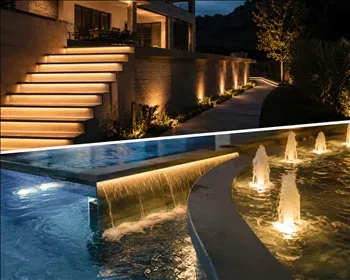
- Swimming pool underwater lighting
- Fountain and water feature illumination
- Aquarium and pond lighting (submerged)
- Boat and yacht marine lighting (below waterline)
- Any application requiring permanent underwater LED installation
Advantages:
- Complete waterproof protection for continuous submersion
- Solid silicone construction eliminates condensation issues
- Excellent chemical resistance (pool chemicals, saltwater)
- Superior UV stability for long-term outdoor/underwater use
- Available in high-output configurations for underwater visibility
Limitations:
- Highest cost — 35–50% more than equivalent IP20 strips
- Most rigid form factor — limited bending radius
- Cutting and re-sealing requires specialized techniques and materials
- Heat dissipation is reduced (silicone is a thermal insulator) — may require lower drive currents or active cooling for high-power applications
- Repair and maintenance are difficult — underwater failures typically require full strip replacement
When choosing between IP67 vs IP68 LED strip lights, the key question is: will the strip be continuously submerged? If yes, IP68 is mandatory. If the strip will be exposed to heavy rain and occasional splashing but not submerged, IP67 is sufficient and more cost-effective.
How IP Ratings Affect LED Strip Performance and Installation
Thermal Management
Higher IP ratings mean thicker silicone or sleeve materials, which act as thermal insulators. This affects heat dissipation:
- IP20: Excellent heat dissipation — components directly exposed to air
- IP44: Good heat dissipation — thin coating doesn't significantly impede thermal transfer
- IP65: Moderate heat dissipation — silicone sleeve or coating adds thermal resistance
- IP67: Reduced heat dissipation — thicker silicone sleeve increases thermal resistance
- IP68: Most limited heat dissipation — solid silicone encasement significantly insulates
For high-power LED strips (15W/m or above), consider using aluminum channels even with IP65+ rated strips to ensure adequate thermal management. This is especially important for IP68 strips used in underwater applications where water actually helps with cooling but the silicone layer still insulates the PCB.
Installation Considerations by IP Rating
Installation Factor | IP20 | IP44 | IP65 | IP67 | IP68 |
|---|---|---|---|---|---|
Cutting | Cut at marked points | Cut + re-seal with silicone | Cut + re-seal with silicone + end cap | Cut + re-seal with silicone + end cap | Cut + specialized re-sealing (professional recommended) |
Connecting | Solder or clip connectors | Solder + silicone seal | Silicone connectors or solder + seal | Waterproof connectors required | Waterproof connectors + silicone seal |
Bending radius | 20mm | 25mm | 30mm | 40mm | 50mm+ |
Mounting | 3M adhesive | 3M adhesive | 3M adhesive + clips recommended | Mounting clips required | Mounting clips + silicone adhesive |
Aluminum channel compatibility | Standard | Standard | Available for sleeve type | Limited (sleeve type) | Limited (custom channels) |
Re-Sealing Cut Ends
One of the most common causes of waterproof LED strip failure is improperly sealed cut ends. When you cut an IP65, IP67, or IP68 strip, the exposed cut end must be re-sealed to maintain the IP rating:
- IP65: Apply silicone sealant to the cut end and install a silicone end cap
- IP67: Apply silicone sealant inside an end cap, press firmly, and allow to cure for 24 hours
- IP68: Use manufacturer-provided sealing kits or professional re-sealing service — improper sealing will cause water ingress and failure
Common Mistakes When Choosing LED Strip IP Ratings
1. Over-Specifying: Using IP68 Everywhere "Just to Be Safe"
While it might seem prudent to use the highest IP rating for all applications, IP68 strips cost 35–50% more, are less flexible, harder to install, and have worse thermal performance. For indoor dry applications, IP20 is perfectly adequate. For outdoor covered areas, IP65 is sufficient. Match the IP rating to the actual environmental conditions.
2. Under-Specifying: Using IP65 for Underwater Applications
IP65 is rated for water jets, not submersion. An IP65 strip installed underwater will fail quickly as water penetrates the silicone sleeve through microscopic pores or unsealed connector points. Always use IP68 for any submerged application.
3. Ignoring Connector and Power Supply IP Ratings
The LED strip's IP rating is only as good as its weakest link. If you use an IP68 LED strip with a non-waterproof connector or power supply, the entire system's effective IP rating drops to that of the connector. Always specify waterproof connectors, junction boxes, and power supplies rated to the same or higher IP standard as the strip.
4. Assuming All IP65 Strips Are the Same
IP65 can be achieved through different manufacturing methods — silicone sleeve (hollow tube) or flat silicone extrusion. The sleeve type can collect condensation in high-humidity environments, while the flat extrusion type is solid and condensation-free. For outdoor use in humid climates, flat extrusion IP65 is preferable.
5. Not Considering UV Exposure
For outdoor applications, ensure the waterproofing material is UV-resistant. Silicone is naturally UV-resistant, but PU (polyurethane) and epoxy coatings can yellow and become brittle with prolonged UV exposure. Always specify UV-resistant silicone for outdoor LED strip installations.
HST Light's Waterproof LED Strip Manufacturing Capabilities
At HST Light, we manufacture LED strips across the full IP rating range using advanced silicone extrusion and coating technology:
Our IP Rating Manufacturing Capabilities
IP Rating | Manufacturing Method | Materials Used | Custom Options |
|---|---|---|---|
IP20 | Bare PCB (no coating) | — | Standard |
IP44 | Silicone glue coating | UV-resistant silicone | Custom coating thickness |
IP65 | Silicone sleeve or flat extrusion | UV-resistant silicone, food-grade options | Custom sleeve color (white/frosted) |
IP67 | Thick silicone sleeve + sealed ends | UV-resistant silicone | Custom connector types |
IP68 | Full silicone extrusion (embedded) | Solid silicone, chemical-resistant grades | Custom silicone color and hardness |
Additional Waterproofing Features
- Marine-grade silicone: For saltwater and pool chemical resistance
- Anti-yellowing silicone: Maintains optical clarity for 5+ years outdoors
- Custom connector solutions: IP68-rated quick connectors for easy field installation
- Pre-cut and pre-sealed options: Strips cut to specified lengths with factory-sealed ends for faster installation
- Compliance testing: All waterproof strips undergo water immersion testing per IEC 60529 standards
Explore our full range of waterproof LED strip products or discuss your custom waterproofing requirements through our OEM/ODM service.
Conclusion
Understanding LED strip IP ratings is fundamental to specifying the right product for each application. Here's a quick summary to guide your selection:
- IP20: Indoor dry areas — maximum flexibility, lowest cost, best thermal performance
- IP44: Indoor wet areas (splashes) — basic moisture protection for bathrooms and kitchens
- IP65: Outdoor covered and exposed areas — the versatile all-rounder for most commercial and residential outdoor projects
- IP67: Outdoor fully exposed with heavy rain — robust protection for permanent outdoor installations
- IP68: Underwater and continuous submersion — the ultimate waterproof protection for pools, fountains, and marine applications
By matching the IP rating to your project's environmental conditions, you ensure product longevity, safety, and customer satisfaction — while avoiding the cost premium of over-specifying or the failure risk of under-specifying.
Need help selecting the right IP rating for your project? Contact HST Light for expert guidance, free samples, and competitive pricing on LED strips across all IP ratings.