Feb 28, 2026LED Strips
LED Strip Lights: How They Work & Key Types Explained
Discover the working principle of LED strip lights and compare flexible, rigid, RGB, and smart types. Learn technical specs, use cases, and how to choose the right LED strip for your project.
LED Strip Lights: How They Work & Key Types Explained
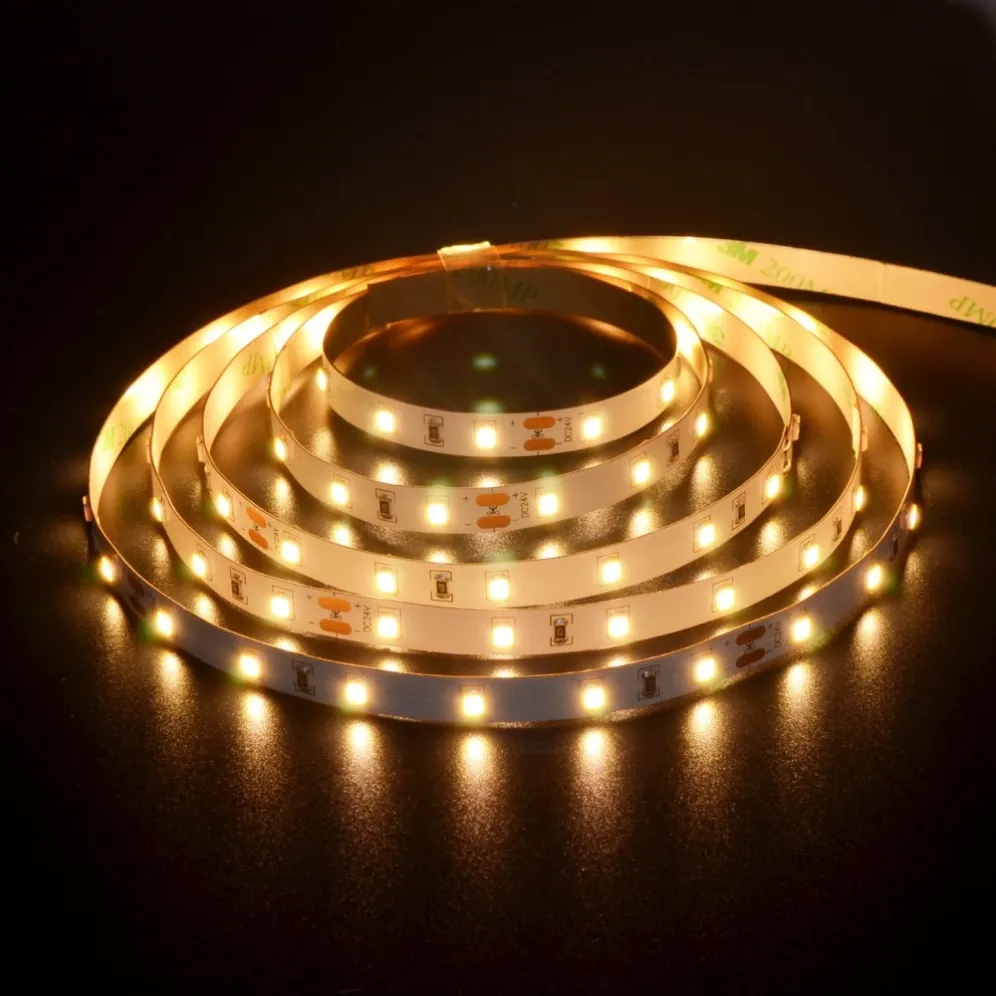
LED strip lights have revolutionized modern lighting design with their versatility, energy efficiency, and seamless integration into residential, commercial, and architectural projects. Whether you’re illuminating kitchen cabinets, creating ambient mood lighting, or designing dynamic retail displays, understanding how LED strips work and their core types is essential.In this guide, we break down the fundamental working principle of LED strips and analyze the key types (flexible, rigid, RGB, and smart) to help you make informed decisions for your next lighting project.
How Do LED Strip Lights Work?
LED strips operate on the electroluminescence principle of semiconductor PN junctions. Here’s a step-by-step technical breakdown:
- Current Flow & Electron MovementA constant-current power supply delivers electricity to the strip. When current flows through the PN junction (formed by P-type and N-type semiconductors), electrons from the N-layer recombine with holes in the P-layer.
- Photon EmissionThis recombination releases energy in the form of photons (light). The color of light depends on the semiconductor material’s bandgap energy (e.g., gallium nitride for blue light, aluminum gallium indium phosphide for red).
- Critical Supporting Technologies
- Thermal Management: Aluminum-backed PCBs or copper traces dissipate heat to prevent lumen degradation.
- PWM Dimming: Pulse-width modulation adjusts brightness without color shift by rapidly cycling power (typically >200Hz to avoid flicker).
- Protection Circuits: IP-rated coatings (e.g., silicone for IP65+) shield against moisture and dust in outdoor/wet environments.
Why This Matters: Unlike incandescent bulbs that waste 90% of energy as heat, LED strips convert 80–90% of electricity into light—making them up to 85% more efficient with lifespans of 30,000–50,000 hours.
Key Types of LED Strip Lights & Their Applications
1. Flexible LED Strips (FPC-Based)
- Structure: LEDs mounted on bendable polyimide (PI) or flexible printed circuit (FPC) boards.
- Key Features:
- Bendable up to 180° without damage
- Adhesive backing for easy installation on curved surfaces
- Typically lower power density (6–14W/m)
- Best For: Cove lighting, furniture accents, automotive interiors, and irregular architectural contours.
- Limitation: Less heat dissipation than rigid strips; avoid high-power (>14W/m) applications.
2. Rigid LED Strips (Hard Strips)
- Structure: LEDs soldered onto rigid aluminum or fiberglass PCBs.
- Key Features:
- Superior thermal conductivity (aluminum substrates)
- Higher lumen output (up to 22W/m)
- Precise beam control for task lighting
- Best For: Shelf lighting, under-cabinet task lighting, retail displays, and industrial workspaces.
- Pro Tip: Use with aluminum channels to maximize lifespan and reduce glare.
3. RGB/RGBW LED Strips
- Structure: Integrates red, green, blue (and optional white) LEDs per segment.
- Key Features:
- 16.7 million color combinations via additive mixing
- Addressable variants (e.g., WS2812B) allow per-LED control
- Requires a dedicated controller (e.g., DMX, 12V RGB amplifier)
- Best For: Entertainment zones (bars, home theaters), dynamic signage, and event staging.
- Critical Note: Non-addressable RGB strips show uniform color; addressable types enable animations (e.g., sound-reactive effects).
4. Smart LED Strips
- Structure: Built-in Wi-Fi/Bluetooth/Zigbee modules with IC drivers.
- Key Features:
- Voice control (Alexa, Google Assistant)
- App-based scheduling and scene presets
- Integration with smart home ecosystems (e.g., Apple HomeKit)
- Best For: Automated home lighting, hospitality environments, and retail ambiance control.
- Must-Know: Wi-Fi strips work without hubs; Bluetooth models require a gateway for remote access.
How to Choose the Right LED Strip Type
Factor | Flexible Strip | Rigid Strip | RGB/RGBW | Smart Strip |
|---|---|---|---|---|
Best Use Case | Curved surfaces | Linear task lighting | Color-changing effects | Automated control |
Max Power | ≤14W/m | ≤22W/m | ≤14W/m | ≤12W/m |
Installation | Peel-and-stick | Requires mounting channel | Needs controller | Needs app setup |
| | | | |
Pro Advice:
- For outdoor use, prioritize IP67-rated strips with UV-resistant coatings.
- For task lighting, choose high-CRI (≥90) white strips (2700K–4000K).
- For smart setups, verify protocol compatibility (e.g., Matter over Thread for future-proofing).
Frequently Asked Questions (FAQ)
Q1: Can I cut LED strips to length?
Yes—most flexible strips have scissor icons marking cut points (typically every 3–6 LEDs). Re-seal cut ends with silicone to maintain IP rating.
Q2: Why is my RGB strip showing color inconsistencies?
This usually indicates voltage drop. For runs >5m, inject power at both ends or use a higher-gauge wire.
Q3: Do smart LED strips need a hub?
Wi-Fi strips (e.g., 2.4GHz) connect directly to your router. Bluetooth strips require a hub (e.g., Philips Hue Bridge) for remote control.
Final Recommendations
LED strip lights offer unmatched flexibility—but success hinges on matching the type to your application. Prioritize:
- Environment (indoor/outdoor, humidity) → Dictates IP rating
- Lighting goal (task/ambient/decoration) → Determines color temperature and CRI
- Control needs (static/smart) → Defines wiring complexity
Ready to implement?
Related Resources
Tags: #LEDStripGuide #SmartLighting #RGBLED #FlexibleLighting #LightingDesign